Thursday, May 3, 2018

MUSIC FESTIVALS

The Ministry of Education and Sports annually organises Music Dance and Drama Festivals in the mont of July and August. The festivals are organised on set themes. Music teachers are first trained on the festivals theme(s) in a workshop for three days. 


This year's themes were: 1- Go to school, Back to school and Stay in school. Go to school appeals to children who have not gone to school for whatever reason to go. Back to school urges those who for one reason or the other left school to return to school; while Stay in school encourages those in school to stay till they complete their studies. 2- The other theme was Good Sanitation Better Living. The Ministry appeals to the public though the children's festival activities to improve their living standards through better sanitation.
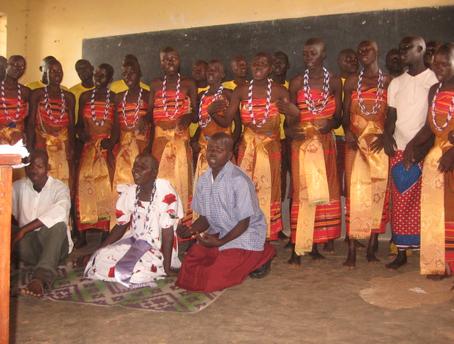

Each school had to prepare 10 items for competition. Four of the ten items were not to reflect the themes. viz: Traditional Folk song,Traditional folk dance, Instrumental composition and Sight Singing. The festival is a real time of festivity. It is also a time for learning for the students at school, teachers and the community.


PEOPLE WILL REMEMBER


As people leave the camps I'm sure there are happenings they will live to remember. Some of the obvious things they will not forget :
  • inadequacy of food,
  • lack of other basic neccessities
But some other problems that the people encountered during their life in the camps are even far worse. One of them is fire out-break. Fires due to carelessness gutted huts in a manner that people lost hope in life. Some of the causes of these fires have not been established up to now. Some believers in witchcraf attributed the causes to witches whom they claimed lived in the camps or just came to the camps to torment camp dwellers. In many cases though, fires were caused by children who had been left at home while their parents went away to look for food.

Other fires however were deliberately set by the notoriuos rebels. If they found time to sneek into the camps, they would turn their anger to the civilians whom they were not able to get and set their huts ablaze. At times this would happen when grass for thatching the huts were not available. The affected families would suffer. Thanks to some of our leaders. They would immediately look round for humanitarian agencies to come in to help. Our churches didn't keep quiet either.

The unfortunate people would be left with barely anything to sustain life. Clothes, beddings, cooking and eating utensils would be lost to the fire. Even the little food they might have would all be swept by the blaze. It's not a pleasant experience.
If people continue to remembr these experiences then they should also remember that war is not a weeding party. Once out of it , we shouldn't get into it forever and ever.

Wednesday, April 25, 2018

ALCOHOL

Alcohol


In every society people take alcohol. But I have not found a community where alcohol is accepted as a completely good thing. Apart from consumers of this drug, most people regard alcohol as an unwanted substance.

In Acholi traditional society, alcohol was used. The manner in which is was consumed, the occasion for it and its preparation differs from what it is now. Acholi people used to prepare their drink from millet flour which they would allow to ferment, roast then mix with water to ferment again for two days. It was then filtered.and served. This is kwete. It was a good drink; taken by elderly men in their late 40's and above. Drinks were taken on occasions like after communal work, at funerals,to welcome guests, at marriage ceremonies or at any other important ritual. In most cases alcohol was not consumed for mere passing time. There was a meaning and a reason for it. Youngsters, the youth and women were not usually part of the drinking crew.
The manner in which alcohol is used this days is not at all pleasing to sober minds. The kind of drink taken, drives one crazy

Today people in this land take both local brew alongside modern ones. Local brew includes cassava gin called arege. It is made from cassava flour more or less the way kwete is brewed but is distilled after fermentation. Another local brew which has high market in the camps is made from bananas. It is " imported" from south-western Uganda. Kesese-kasese is its name It is a more potent gin which drives young men crazy. It's their favorite. 
A youth collapses after dinking


The traumatic time that our young men experienced because of the long war is responsible for their irresponsible drinking habit. School drop-outs see no value in life; so take to drinking. Men whose families have broken also bury their frustration in booze. Jobless youths who have undergone some education do fall prey to the "culture"

It can not go without say that the women-folk do not drink. A good many of them too make up the crew. Some young women whose families have broken, or are frustrated in life make friends with the glass.

I have mentioned local brew. Modern drinks also play some role in the drinking arena. The most commonly consumed type of drink in this case are the drinks packed in sackets.There are many of them. This kind of packaging is the most damaging because is easy to carry. Students carry it to class un-noticed. Drivers love it because no one notices they are carrying something. Even some people in offices love it so much.
As our people return home, the youth especislly should :
  • be made aware of the dangers of alcohol,
  • be engaged in some productive work,
  • have some other varried leisure activities.
  • be engaged in some skill training programmes and
  • for those still able be re-absorbed in formal schools.
I would like to conclude that AN IDLE MIND IS THE DEVIL'S WORKSHOP so idleness and redundancy must be eliminated.

-JOKONDINO-


'

WATER SHORTAGE IS A THREAT TO THE RETURNEES


 Edit 1 6…
millet- the staple crodp of the people of northern uganda growing in the ffield
I took some time to move a bit and see what life the returned people are living. The response I got were very encouraging. They claim that nearness to their land was good; that they can protect the land and manage it well.

Returnees also claim that food shortage that was one of their problems in the camp will be history. Able bodied men brag that the time had come for them to work hard and aquire wealth. They sneer at those still living in the camp.

I saw crops planted in fairly large gardens. Fields are not overgrown with weeds as it used to be when people walked long distances to the fields. The site is exciting. Millet, the staple food crop of this part of Uganda is doing well in many gardens.

What is unpleasant for the returnees is the lack of clean, safe water. Most water sources in the return sites are unsafe. Many of the natural wells have either dried up or have inadequate water supply. To make it even worse these sources are surface water. Likelihood of water-borne diseases are eminent.

ENVIRONMENTAL DEGRADATION


In as much as it is true to say that life in the camp caused a lot of problems to the people, the environment didn't escape the wrath of the displacement of the people either. Trees were first in the line up. As people came to the camps they used trees for putting up structrures for shelter. Where trees once existed was cleared to give room for construction of huts. Then the question of wood for fuel came in. Our country being a third world country still relies on organic resources for energy. So as time went on, trees near the camps were depleted. The need for charcoal later came in . This gave rise to indisciminate cutting of trees outside the camps. 
most of the trees in or near the camps were destroyed
Trees at the river banks suffered the most. Felling of these trees could be the most likely cause of the drying up of many water sources.


The soil also suffered. As trees were wiped out the soil automatically lacked cover so became vulnerable to agents of soil erosion.

The soil also suffered as people threw away used polythene bags. Since these bags do not decompose, they have become real litter to the soil. More so they also intefere with drainage,growth of roots of plants etc.

Although the government of Uganda has put in place some laws regarding the use of these polythene bags nobody seems to pay any heed neither has anyone been punished for it.

It will take sometime and effort in order to recover the value of the land in and around places that the camps have occupied.

ORPHANS

Orphans- who will care for them?
 Edit 0 5…


The war in northern Uganda created so many untold suffering to the people in the north and north-east of the country. One of the most serious effects of this war is the loss of men and women who had children to bring up Many people were either killed by the waring factions or died of the dreaded AIDS disease. The result of result of these two, has given rise to : child headed families and orphans without substantial persons to look after them.

A good many of us wonder how these children will fend for themselves once they are out of the camps where there was at least relief supplies. One may wonder whether there were no orphans in the north before the war. True we had some orphans but of a manageable number. 
jennet lost her father to the war and mother to AIDS

Some NGO's have been endevouring to help these needy children but how long they will continue is not known. What these orphans need are:
  1. food
  2. shelter
  3. educational needs
  4. psycho-social support and
  5. clothing

It our hope that the local leaders and elders will help these children to settle in the land once owned by their parents. If they don't, then these children will have nowhere to go to.

Drawing Nearer To God


One of the good things that people acquired from the camp is the commitment to God. Many 
 christians' faith had eroded away and so needed to be drawn to prayer. Unbaptised youths joined the evening classes in preparation for baptism and were baptised. Couples that had long since been joined through traditional marriage came and took "vows" in the house of the creator. What I am writing is not what is past but what is happening even now.


Church attendance on Sundays is amazingly high. The liturgy became more lively with a large performing choir. The liturgical dancers do add to the ornament of the service. During the vacations students--especially those in the scholarship program--take turns in reading the word of God. All is beautiful.

I can not leave mention of the Lay Apostles who endevoured to see that the moral fibre of the people didn't degenerate completely. Their efforts to conduct prayers of the rosary were commendable.

Our catechists at Pagak didn't leave their flock unattended to.They kept with us at all these trying times. May the Good Lord reward them abundantly.

What will happen as the people go home is yet unpredictable. The church will be some distance away; the catechists will not be at arms-reach. But all the same WITH GOD NOTHING IS IMPOSSIBLE.

Thank you
JOKONDINO